
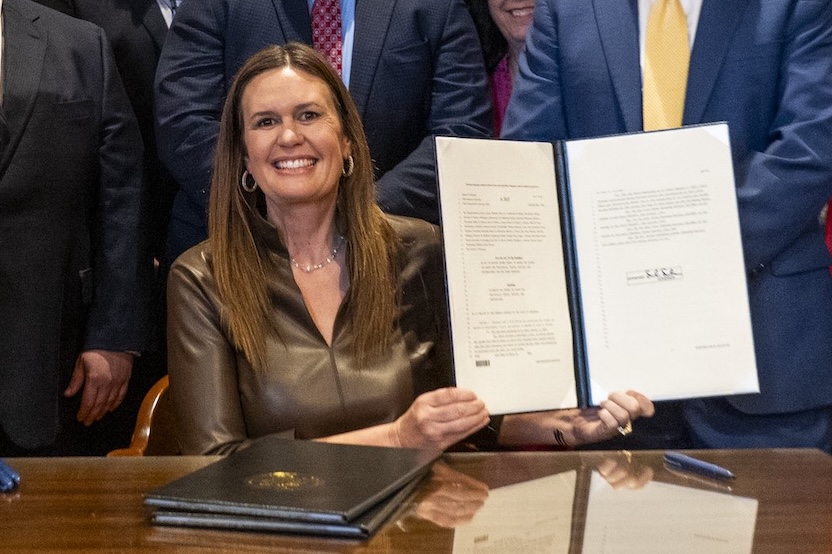

Arkansas – Arkansas Governor Sarah Huckabee Sanders has signed two major tax reduction bills into law, marking another step in the state’s ongoing effort to lower income tax rates for individuals and businesses.
The legislation includes House Bill 1001 and Senate Bill 1, both of which were passed during a 2026 special legislative session focused on tax relief. According to legislative summaries, the bills reduce income tax rates for individuals, trusts, estates, and corporations beginning in 2026 and 2027.
House Bill 1001 and Senate Bill 1 reduce Arkansas’ top individual income tax rate from 3.9% to 3.7%, effective January 1, 2026. The corporate income tax rate will also be reduced, moving from 4.3% to 4.1% beginning January 1, 2027.
State reporting confirms that both bills were passed as part of a coordinated tax relief package and signed into law by Governor Sanders on May 6, 2026.
The legislation applies not only to individual taxpayers but also to trusts and estates, continuing a broader tax structure reform that has been gradually implemented over multiple legislative sessions.
Arkansas has been steadily lowering income tax rates in recent years. Lawmakers previously reduced the top individual rate from 4.4% to 3.9% and the corporate rate from 4.8% to 4.3% during earlier sessions, according to legislative records.
The 2026 tax cut package continues that trend, with Republican leaders arguing that the reductions are supported by the state’s strong financial position, including surplus revenue and reserve funds.
Governor Sanders called lawmakers into a special session specifically to consider additional tax cuts after the state completed its budget work.
According to the Arkansas Advocate and legislative analysis, the cuts are expected to affect more than one million individual taxpayers and several thousand corporations.
The state Department of Finance and Administration estimates that households with taxable income above roughly $26,000 will see reductions under the new structure.
Supporters of the legislation argue that the cuts will increase competitiveness with other states and encourage economic growth, investment, and job creation.
Republican lawmakers have pointed to Arkansas’ relatively strong revenue collections and reserve balances as justification for reducing tax rates further.
The bills also reflect ongoing efforts by state leaders to position Arkansas as a lower-tax state in the region, continuing a multi-year policy direction that has reduced both personal and corporate income tax rates.
While the bills passed through the legislature with Republican support, some advocacy groups and policy organizations raised concerns about long-term impacts on public services.
Opponents argue that continued tax reductions could limit funding for education, healthcare, and social programs.
During committee hearings, critics warned that reductions in revenue could place pressure on state services, especially during periods of economic uncertainty.
Despite the debate, the measures advanced through both chambers and were ultimately signed into law by Governor Sanders.
With the signing of HB1001 and SB1, Arkansas continues its gradual shift toward lower income tax rates.
The changes will take effect in stages beginning in 2026, with full implementation of corporate rate reductions scheduled for 2027.
State officials say additional fiscal impacts will be monitored as the changes take effect, while lawmakers may revisit tax policy in future sessions depending on revenue performance.