
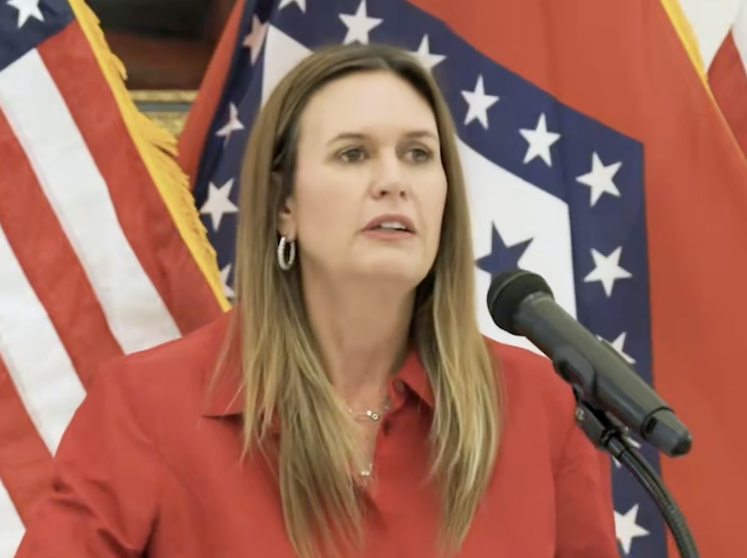

Arkansas – Arkansas Gov. Sarah Huckabee Sanders criticized Democrats after a New York Times investigation reported that aides connected to Democratic Senate candidate Mary Peltola and the Democratic Senatorial Campaign Committee were involved in efforts to recruit another candidate named Dan Sullivan in Alaska’s closely watched U.S. Senate race.
“Democrats’ big idea to beat Dan Sullivan: another Dan Sullivan. Because misleading voters is easier than winning them over,” Sanders said, sharing a report by New York Times journalist Kellen Browning.
The report alleged that operatives connected to Peltola’s campaign, campaign attorneys and senior officials at the Democratic Senatorial Campaign Committee participated in a months-long effort to recruit candidates who could potentially draw votes away from Republican Sen. Dan Sullivan, who is seeking reelection.
According to reporting by the New York Times, the effort eventually led to the recruitment of Dan J. Sullivan, a retired schoolteacher from the small fishing community of Petersburg, Alaska. He is now one of four candidates appearing on the state’s November 3 general election ballot.
The situation has attracted national attention because the two candidates share the same first and last name, creating concerns that voters could mistakenly select the wrong Sullivan when casting their ballots.
An Associated Press report published October 28 said the newspaper obtained text messages between members of Peltola’s campaign discussing the possibility of recruiting people with names matching the Republican incumbent. The messages, along with interviews and other material reviewed by the Times, reportedly showed that the effort involved more than one person connected to the Democratic campaign.
The report also cited former Peltola campaign manager Elisa Rios, who said Peltola was aware of the effort but was not directly involved in recruiting the second Sullivan. Rios had been dismissed from the campaign in August and later reportedly attempted to retract statements she had made to the newspaper.
Peltola’s campaign denied involvement in either Sullivan’s campaign, issuing a statement saying it had no connection to either candidate. The Democratic Senatorial Campaign Committee also denied participating in the effort.
The DSCC pushed back against the allegations, arguing that Republicans have previously supported candidates in Alaska elections in ways intended to influence the outcome. The organization pointed to earlier efforts involving candidates who ran against Peltola and other Democratic candidates.
However, the New York Times investigation prompted renewed criticism from Republicans, who accused Peltola’s campaign and national Democratic operatives of attempting to manipulate the ballot and deliberately create confusion among voters.
The campaign of Sen. Dan Sullivan also responded to the report. Nate Adams, a spokesperson for the Republican senator, said Alaskans deserved the truth and accused Peltola, her campaign and senior advisers of working with national Democratic operatives and attorneys to recruit candidates to confuse voters.
Investing reported that it had not independently verified the New York Times’ findings but detailed the allegations and the responses from both campaigns. The outlet also reported that Peltola dismissed the controversy as a distraction while campaigning, saying her focus was on affordability and the cost of living.
The controversy is particularly significant because Alaska’s Senate race could help determine which party controls the chamber after the November midterm elections. Republicans currently hold a 53-47 majority, meaning Democrats need to make significant gains to take control of the Senate.
Alaska uses a ranked-choice voting system in its general elections. Voters can rank candidates in order of preference, rather than selecting only one. On the ballot, the incumbent Republican is identified as Dan S. Sullivan, while the other candidate appears as Daniel J. Sullivan Jr. and is listed without a party affiliation.
The second Sullivan’s candidacy had already faced legal challenges before the latest reporting. State election officials initially sought to keep him off the ballot, arguing that his candidacy was intended to confuse voters and undermine the fairness of the election. However, the Alaska Supreme Court ruled that he could remain on the ballot after he advanced through the state’s August primary.
The controversy has also become part of a broader legal dispute. The U.S. Department of Justice filed a lawsuit seeking to prevent certification of the Senate election results if the Republican incumbent loses by a margin smaller than the number of votes received by the second Sullivan. The lawsuit argues that the presence of the similarly named candidate could create voter confusion.
Following the New York Times report, Alaska Gov. Mike Dunleavy announced that he was directing the state’s Department of Public Safety to investigate whether the alleged recruitment effort violated state law and whether criminal charges or civil action could be warranted.
By October 30, the U.S. attorney in Alaska had also confirmed that federal authorities were investigating allegations surrounding the second Sullivan’s candidacy, according to The Washington Post. The prosecutor declined to discuss potential targets or investigative steps.
Peltola has denied knowing about a scheme, while Dan J. Sullivan has maintained that his candidacy is legitimate.
Sanders’ criticism adds another Republican governor’s voice to the growing national backlash over the allegations, with the dispute unfolding just days before Alaska voters head to the polls.