
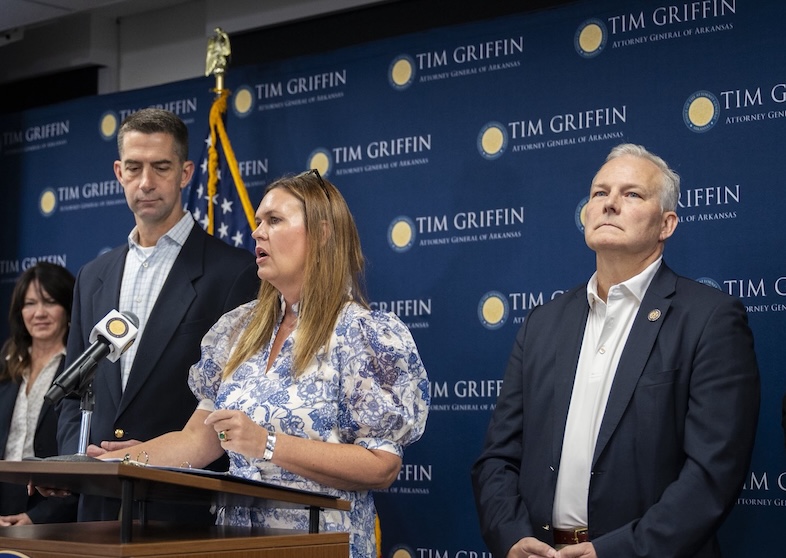

Arkansas – U.S. Sen. Tom Cotton said Medicaid fraud does more than cost taxpayers money, arguing that criminal schemes also threaten access to health care for Arkansans who depend on the program.
“When criminal fraudsters steal Medicaid funds, not only are they padding their own pockets with the dollars of hardworking taxpayers, but they are stripping away access to healthcare from Arkansans who depend on it,” Cotton said in a post on Aug. 14. He also thanked Gov. Sarah Huckabee Sanders and Arkansas Attorney General Tim Griffin for their efforts to combat Medicaid fraud and said he supported the STOP FRAUD in Medicaid Act at the federal level.
Sanders echoed that message the following day, saying her administration was working with Cotton and Griffin, as well as President Donald Trump and Vice President JD Vance, to increase enforcement against Medicaid fraud.
“Fraud is wrong. Especially in Medicaid, designed to help our most vulnerable people,” Sanders said Aug. 15. “That’s why my administration, Sen. Tom Cotton, and AG Tim Griffin are partnering with President Trump and VP Vance to crack down on fraud and protect taxpayers.”
The comments came as Arkansas officials joined a broader effort to give states additional authority to investigate and prosecute Medicaid beneficiary fraud.
The effort centers on the STOP FRAUD in Medicaid Act, legislation introduced in Congress that would expand the role of state Medicaid Fraud Control Units, or MFCUs. Under current federal rules, those units primarily investigate and prosecute fraud committed by Medicaid providers. The proposed legislation would allow them to also investigate and prosecute fraud involving Medicaid beneficiaries and recipients.
The Senate version, S. 4176, was introduced in March by Sens. Ashley Moody, R-Fla., and Joni Ernst, R-Iowa, and was referred to the Senate Finance Committee. A House version, H.R. 5364, was introduced by Rep. Derek Schmidt, R-Kan., and referred to the House Energy and Commerce Committee. Neither measure had advanced beyond its respective committee as of the latest congressional records.
Griffin has already taken part in the state-level push for the legislation. On Aug. 4, he joined 16 other attorneys general in asking congressional leaders to approve the measure.
Griffin said the legislation would allow MFCUs to investigate and prosecute beneficiary and recipient fraud, which he described as an area currently outside their federally funded enforcement authority. He pointed to the existing record of state Medicaid fraud units in pursuing provider fraud, arguing that the same investigators and prosecutors should be given authority to address fraudulent activity by recipients.
The coalition’s letter highlighted the amount of money recovered through existing Medicaid fraud investigations. According to figures cited by the attorneys general from the U.S. Department of Health and Human Services Office of Inspector General, state MFCUs recovered nearly $2 billion through criminal and civil cases during fiscal year 2025. The same data showed that MFCUs recovered about $4.64 for every dollar spent by the states and federal government. Their investigations and convictions also resulted in roughly 900 individuals and entities being excluded from federal health care programs.
Arkansas was among the states that joined the coalition supporting the legislation. Other participating states included Alaska, Florida, Idaho, Indiana, Kansas, Kentucky, Louisiana, Mississippi, Missouri, Nebraska, New Hampshire, North Dakota, Oklahoma, South Carolina, South Dakota and West Virginia.
The proposed change would not replace the existing enforcement system. Instead, it would expand the types of Medicaid fraud state units could pursue with federal support.
The distinction is important because Medicaid fraud can involve both providers and individuals receiving benefits. Under the proposed legislation, state fraud control units would gain explicit authority to investigate fraud connected to the application for or receipt of Medicaid services, in addition to fraud involving providers.
The push comes as federal and state officials have increased their focus on identifying improper Medicaid spending and strengthening oversight of programs funded by taxpayers. Federal health officials have also emphasized using data analytics and other tools to identify suspicious billing and prevent fraudulent payments before money leaves government accounts. The Centers for Medicare & Medicaid Services has described the approach as moving away from a traditional “pay and chase” model toward detecting and stopping fraud earlier.
For Arkansas officials, the issue has become part of a broader focus on protecting public funds and preventing abuse of programs intended for vulnerable residents.
Cotton said Medicaid fraud ultimately affects people who legitimately rely on the program, while Sanders framed the effort as a way to protect both taxpayers and the people Medicaid was created to serve.
The STOP FRAUD in Medicaid Act remains pending in Congress, meaning additional action by lawmakers would be required before the proposed expansion of state Medicaid fraud enforcement authority could become federal law.