
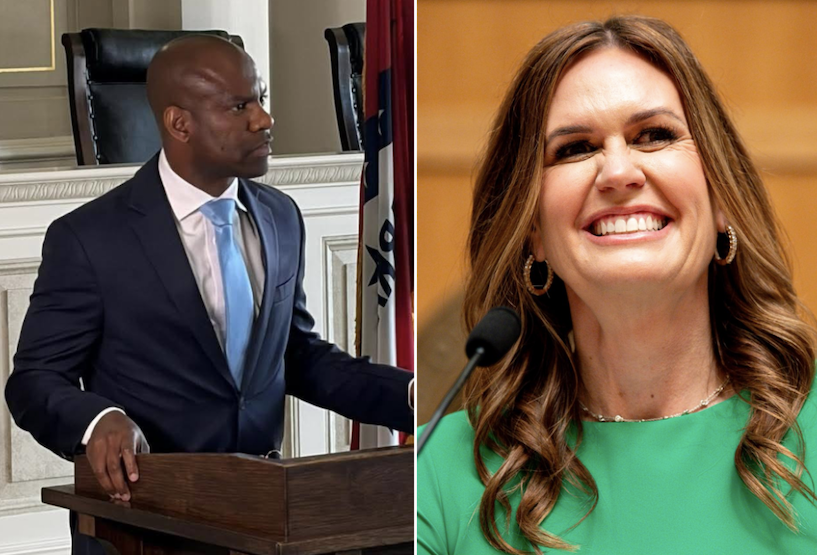

Arkansas – Arkansas Democrats in the state legislature have sharply criticized Governor Sarah Huckabee Sanders following her State of the State address, arguing that her priorities are disconnected from the financial realities facing everyday residents.
Democratic lawmakers, including state Senator Fred Love, said there is a widening gap between what the governor is promoting and what working families are actually experiencing, especially with rising costs of living, childcare, and public services.
Democrats said Sanders is focusing too heavily on tax cuts and school voucher expansion rather than addressing broader economic pressures. Love said the governor’s approach favors wealthier Arkansans while leaving middle- and lower-income families struggling with affordability challenges.
Education funding and school vouchers
A major point of dispute is Sanders’ proposed $6.7 billion state budget, which includes up to $379 million for Arkansas’ school voucher program, known as Education Freedom Accounts. Sanders defended the program by saying Arkansas “cannot allow a child’s destiny to be determined by their ZIP code or the size of their parents’ bank account,” arguing that school choice improves opportunity, AA reported.
Democrats strongly disagreed with this approach. House Minority Leader Andrew Collins said directing public funds toward private schools is not equally fair across the state, especially in rural areas where private school options are limited or nonexistent. He also noted that even when private schools are available, vouchers often do not cover full tuition, making access uneven.
Collins said Democrats would prefer to eliminate vouchers entirely, but if the program continues, they want stricter rules such as transparency requirements, income limits, and caps on funding to ensure accountability.
Concerns also exist within the Republican Party. Representative Jim Wooten criticized the voucher system, saying it lacks oversight and could harm the broader public education system. He warned that while the program currently serves a smaller group of students, it affects funding for hundreds of thousands of children in public schools. He described it as lacking “controls” and “accountability.”
Some Republicans take a more cautious position. Senator Brad Simon said safeguards are needed to ensure Education Freedom Account funds are used properly. However, other GOP lawmakers, including Representative DeAnn Vaught, expect few major changes during the current session.
Tax cuts and budget priorities
Tax policy is another major dividing line. Governor Sanders has already overseen three rounds of income tax cuts since taking office and is pushing for additional reductions. She argues that cutting taxes improves affordability and reflects strong state revenue conditions.
Republican leaders like Senator Jonathan Dismang support the cuts, pointing to a state budget surplus and arguing that taxpayers should benefit from excess revenue.
Democrats strongly oppose this approach. Senator Fred Love said tax cuts mainly benefit wealthier Arkansans while reducing funding for schools, healthcare, childcare, and other essential services. He argued that these decisions shift financial pressure onto working families. He also highlighted rising costs in areas such as childcare and fuel for farmers, saying these issues are not being adequately addressed.
Some Republicans, including Senator Ron Caldwell, also expressed caution, warning that repeated tax cuts could eventually reduce the state’s financial stability if revenue declines too far.
Public safety and prison debate
Public safety is another unresolved issue. A proposed 3,000-bed prison in Franklin County has faced repeated resistance in the legislature, including multiple failed funding attempts. Although Governor Sanders did not emphasize the project in her recent address, Democrats believe it remains a priority for her administration.
Republican leadership has suggested the prison may not come up again during the current fiscal session, but some lawmakers disagree. Senator Fred Love believes it will likely resurface in future debates.
Senator Ron Caldwell, who opposes the project, said he does not see it as a guaranteed priority in the short term. He said he supports improving prison capacity but believes the state should focus more on reducing recidivism rather than building large new facilities.
Political balance in Arkansas
Despite strong criticism from Democrats, Republicans maintain firm control of the Arkansas legislature, holding a supermajority in both chambers. This limits Democratic ability to block legislation and means most of Governor Sanders’ proposals are likely to advance.
Democrats say their role is largely to challenge policy direction and highlight concerns about affordability and fairness, even if they lack the votes to stop most measures.
Overall political direction
The current political debate in Arkansas centers on competing visions for the state’s future. Republicans, led by Governor Sanders, emphasize tax cuts, school choice, and law enforcement funding. Democrats argue for stronger investment in public education, expanded social services, and tighter controls on state spending. The result is an increasingly polarized legislative environment where major policy decisions reflect deep disagreements over priorities and long-term economic strategy.