
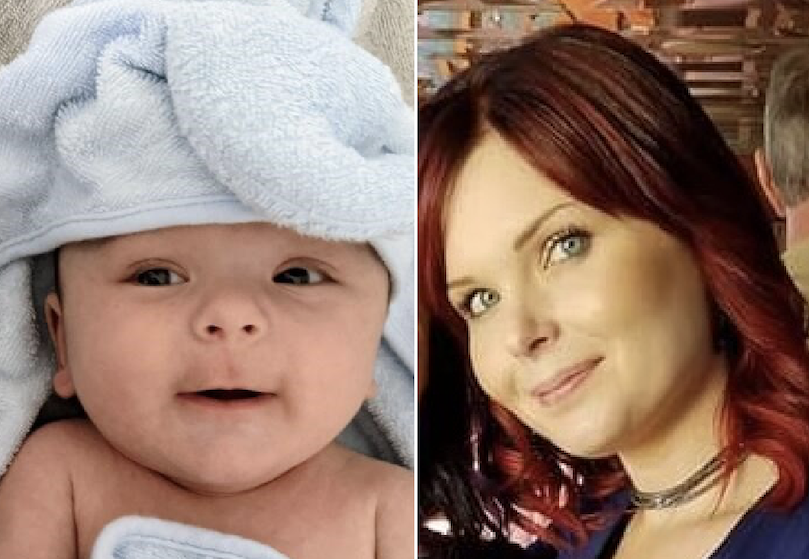

Florida – A Florida woman was sentenced to a decade behind bars on Monday for the mansIaughter of her 3-month-old baby, Dominik, in a case that drew national attention and months of investigation. The parent, 35-year-old LiIy, was originally charged with second‑degree murder after medical examiners ruled the baby’s death a homicide due to serious head trauma, but prosecutors and her defense ultimately agreed to a reduced charge of mansIaughter under Florida law because they determined there was no evidence of maIicious intent required for a murder conviction. She also received four years of probation to follow her prison term. With credit for nearly four years already served in custody since her arrest, she is expected to spend about five more years in prison.
According to the Florida authorities, the case began in Nov. 2021, when neighbors and emergency responders became alarmed after the mother ran from her home carrying her unresponsive chiId. One neighbor, a nurse, began performing CPR on the lnfant until paramedics arrived, and the child was rushed to a hospital. Doctors reported that the baby showed signs of head trauma and no brain activity. He was placed on life support and died a few days later. An autopsy revealed multiple injuries, including bruising on his head, a prior skuII fracture and bIeeding in the brain — findings medical staff said were consistent with serious blunt force trauma.
Investigators from the Sheriff’s Office and medical personnel spent months piecing together the circumstances of the child’s injuries. Court documents showed that he had suffered a series of injuries over time while in his mother’s care. Several months before the child’s death, she reportedly dropped the baby from a recIiner while burping him, an incident she later admitted to police. Florida authorities also learned that the baby had two broken legs when he was about three weeks old, though she had attributed that to an accidental fall.
The medical examiner’s office concluded that the baby’s death was a homicide caused by repeated blunt impacts to the head, a determination that prompted prosecutors to charge her with second‑degree murder when she was arrested. However, those charges were eventually reduced to mansIaughter in light of legal arguments from her defense that she did not act with a “depraved mind” or maIicious intent, which is required for a murder conviction under Florida law.
During the investigation, she gave statements to law enforcement about what happened on the night her child became unresponsive. According to testimony, she said she tried to feed the child a bottle around 9 p.m., but he would not take it and seemed “drowsy.” She placed him in his bed and then went to watch television with her older son for about 20 minutes. When she returned to check on the baby, she found him unresponsive. Some reports indicate that she was unable to locate her phone during that moment of panic, and she ran outside screaming for help. Eventually she carried him to a neighbor’s home where CPR was attempted.
Paramedics arrived at the neighbor’s home and performed life‑saving measures before he was taken to the hospital. Doctors confirmed the extent of his injuries and reported no brain activity. The combination of past injuries, evidence of repeated trauma, and the severity of the head wounds led investigators to conclude that his death was not accidental, even as the mother’s defense sought to frame it as tragic negligence rather than intentional harm.
At her sentencing at the end of December 2025, the womans family and in‑laws offered differing views in court. Her parents expressed disbelief that she intentionally harmed the baby, saying they could not imagine her hurting her grandson. In contrast, her brother‑in‑law described the lasting impact of the baby’s death on the family and supported a harsher punishment. Prosecutors also commented after the sentence that they believed the ten‑year term was insufficient given the seriousness of the child’s injuries.
The mother is expected to serve the remainder of her sentence under Florida law and will be subject to supervised probation following her time in prison. She remains presumed innocent of any act beyond what was proven in court, as is standard in the U.S. legal system.